Another unforgettable moment occurred while wandering the grounds of Opossum Creek Retreat after breakfast at Birding By Butt. Walking with Doug Sanchez (welcome to The Flock, Doug. You fit in perfectly!) and Susan Kaiholz-Williams, we came across a yellow lady slipper. Susan remarked that it looked like a yellow scrotum. I said it had Hasidic Jew side curls. That's all it took. We all broke into uncontrollable giggles for long, long minutes. I will never be able to look at this beautiful wildflower the same way again.
Thursday, July 7, 2011
New River Festival - Belated Post #1
Another unforgettable moment occurred while wandering the grounds of Opossum Creek Retreat after breakfast at Birding By Butt. Walking with Doug Sanchez (welcome to The Flock, Doug. You fit in perfectly!) and Susan Kaiholz-Williams, we came across a yellow lady slipper. Susan remarked that it looked like a yellow scrotum. I said it had Hasidic Jew side curls. That's all it took. We all broke into uncontrollable giggles for long, long minutes. I will never be able to look at this beautiful wildflower the same way again.
Sunday, April 10, 2011
Arizona and Life Bird #300
This May (a few short weeks away!) brings two wonderful birding trips to my bird-deficient work-intensive life. The first is a half-week at the always-popular New River Birding and Nature Festival in Fayetteville, West Virginia. Accurately described by Jeff Gordon, ABA President, as "summer-camp for birders", New River is warbler heaven in one of the most beautiful places on earth - green, rolling mountains, white-water rivers, gorgeous sunsets over the gorge, breathtaking flora and a gathering of the noisiest, most gregarious and boisterous group of birders ever to assemble in one place - The Flock. Spending any amount of time with these wonderful women (and a few men) re-energizes my soul and I miss them terribly. The Cerulean warbler is my target bird for this trip - I missed it on the 2009 New River trip and it has been my nemesis bird for five years. I know Geoff, Keith, aka Paco, and the other trip leaders will make sure to find it for me. If I can put in my request now, I would like them to deliver a Cerulean to my hotel room as I drink my morning coffee. Now that is the kind of service one can expect at New River and Opposum Creek! 
Stellar Jay
Juniper Titmouse (a target species for this trip)
Saturday, February 19, 2011
70 Degrees in February
Saturday, November 13, 2010
Cape May Part Two - It's All About the Birds

This year Cape May had the largest autumn migration fall-out in over 10 years. Driving to early morning field trips, I had to drive 10 miles an hour to avoid running over the dozens of birds on every paved surface - even the middle of the street. I had to stop the car at one intersection to pick up an exhausted sparrow who didn't move when my car approached and put him on the side of the road where he would be safer. The sky and trees were dripping with birds. Thousands of robins, yellow-rumps and sparrows, tree swallows (along with a lifer cave swallow), finches and kinglets flew through the night and landed in Cape May to rest and feed before continuing migration. Dozens of raptors wheeled through the sky at any given moment.
My picture taking ability is limited to large birds perched close, so all the bird pictures I have are of mute swans. The most exciting birds I saw were the raptors - dozens of sharp-shinned hawks, Cooper's hawks perched on telephone wires and calling to each other, then flying down to the ground only yards away where I could get good looks at their patrician profiles. An osprey, immature and mature bald eagles, both turkey and black vultures, dozens of harriers (where I learned to identify the juveniles by their gorgeous buffy rufous bellies), red-shouldered and red-tailed hawks, peregrine falcons (!!!), broad wing hawks and dozens of kestrels were highlights of the weekend. There is no place like Cape May for raptor watching.
y Point Park(click to enlarge and view the spectacle of hundreds of birds in flight)
Sunday, November 7, 2010
Cape May Autumn Migration - It's All About the People
But mostly, the weekend was about the people - my birding peeps. Birding experts and heroes (Pete Dunne, Bill Thompson III, Louise Zemaitis, Jeff Gordon, etc), founding members of the Blogger Flock (who embraced me as one of their own at this very Festival three years ago) and newly-found bird friends and all-around wonderful people.
After arriving Thursday evening from business in Harrisburg, I hit the early morning Friday field trip at The Beanery. My first friend sighting was Jeff Gordon, newly appointed president of the American Birding Association and his lovely first lady, Liz Gordon. Then other friends arrived: Laura, Susan, Delia and Delia's partner AB.
Lots of hugs, giggles and catching up, interspersed with some birding, ensued. Throughout the next three days, we traveled Cape May marveling at the birds and enjoying each other's company.
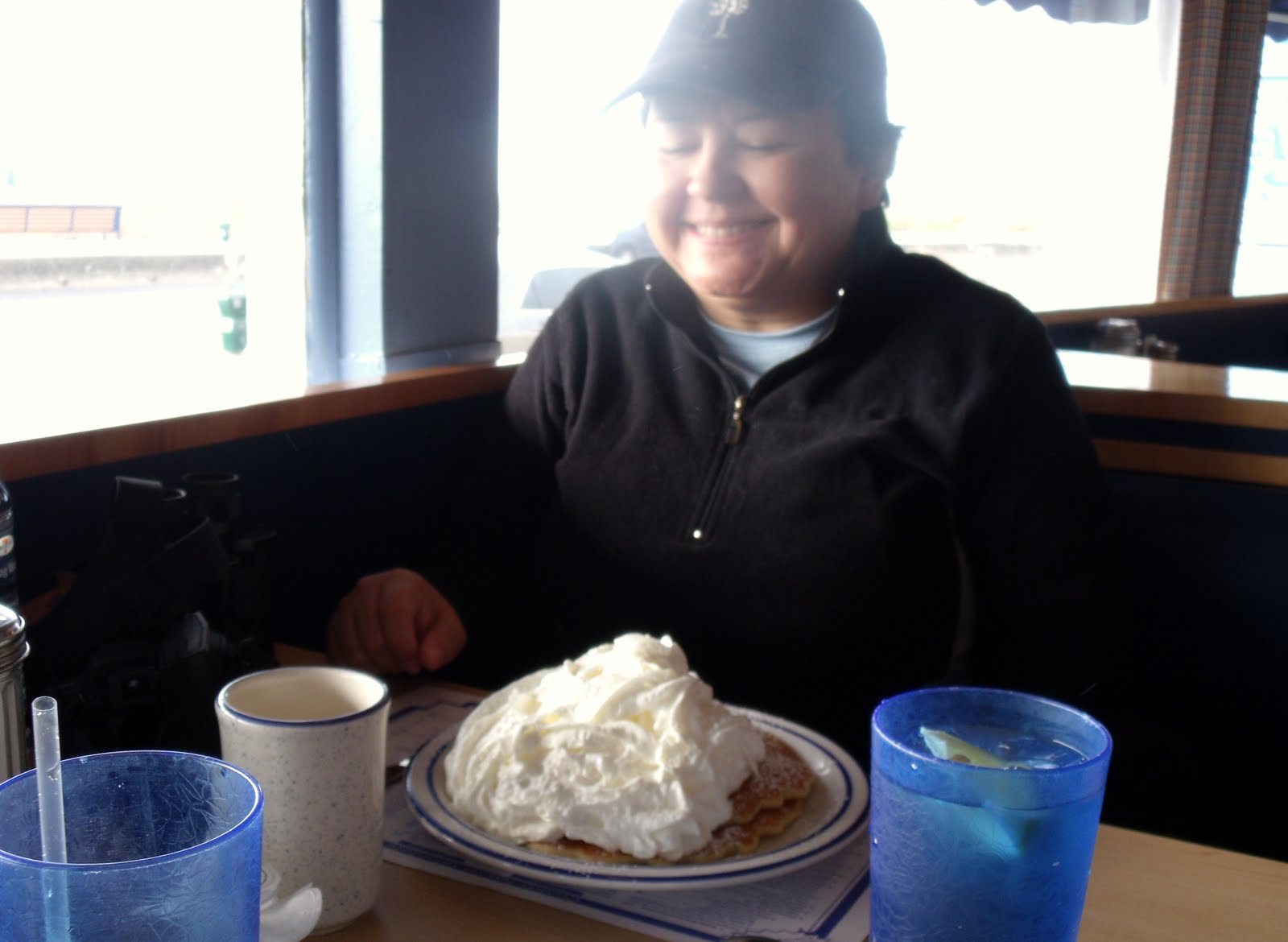
Top left: Jeff and Liz Gordon leading a field trip at The BeaneryTop right: Delia getting ready to enjoy whipped cream with a side of blueberry pancakes at Uncle Bill's
A recent study by a psychologist at Stanford University concluded that one of the best things a man can do for his health is to be married while one of the best things a woman can do for her health is nurture relationships with other women. The myriad ways we connect with our women friends, offering unconditional support in tough times, love and laughter in good times and sometimes just an easy quiet being is undoubtably good for our souls. Being able to share our feelings in a non-threatening atmosphere boosts levels of serotonin, helping combat depression and foster well-being.
photo courtesy of Laura HardySaturday, June 12, 2010
Pelagic Birding Off Cape Hatteras, NC
I drove to North Carolina and Uncle Jim and I birded Lake Mattamuskeet, Pea Island and the Outer Banks (to be covered in another blog post) on the way to Cape Hatteras where at daybreak on Saturday, we boarded the Stormy Petrel II, owned and operated by Brian Patteson and his wonderful staff.
We left dock at 6:00am to head to the gulf stream (a two hour and twenty minute top-speed ride). Lots of fun, if a bit damp. The only time I got queasy was when I went into the bathroom. The enclosed space and the rocking motion made for a bad time, but once out in the fresh air where I could see the horizon, I was just fine. I even managed to eat lunch without getting sick.
Once we got out to the gulf stream, we saw dozens of Wilson's storm-petrels (they soon became the trash bird of the trip - they stayed with us the entire time we were on the gulf stream). They danced and fluttered on the ocean partaking of the menhaden oil that the Stormy Petrel II staff spread on the water to attract more birds. Wilson's storm-petrels dip their feet into the water as they feed, "paddling" to either hover over the food source or perhaps stir up more food. It gives an impression of seabird butterflies. Beautiful and magical. White-rumped storm-petrels soon joined in. I could not tell the difference between the two - the field guides say that the white-rumps have a divided rump patch, but with the speed of the birds and the rocking motion of the boat, all I could see was a brown bird with a white rump.
Suddenly, there was a big ruckus at the front of the boat. A group of six false killer whales was spotted. They gave us great looks as they swam close to and under the boat, almost playing with us. Dolphins, sunfish and flying fish rounded out the ocean wildlife for the day. Then, sooty and manx shearwaters flew in. Awesome - two more lifers for a total of 8 pelagic species for the day.
After a seafood dinner and a good night's sleep, we left for Ocraoke Island and the Cedar Island ferry, making our way back home. Thanks to Uncle Jim and the crew of the Stormy Petrel II for a fabulous time.
Sunday, February 21, 2010
Dispatch from Space Coast - Day Four
It was interesting to watch the individual criteria each expert uses for identifying birds and see how they reach the same or different conclusions. Sibley and Jaramillo are specific and scientific in their identifications, whereas Dunne is more emotional in interpretations. For instance, instead of giving us specific field marks to identify a reddish egret, Pete Dunne likens the way they move to "linebackers who dropped a tab of crystal meth". Now that is an image I won't soon forget and the next day, when I saw my lifer reddish egret, I couldn't have agreed more. He also compared a red-shouldered hawk's hunched appearance to Winston Churchill.
Winston Churchill (or maybe Alfred Hitchcock) on a pole at Viera Wetlands
Garnering an even bigger audience laugh, Pete Dunne tried to explain the difference between short and long-billed dowitchers. Short-bills have blunter and heavier bills and smudgier markings than the long-billed. He described the long-billed as "gentrified" and the short-billed as "shabby". "You wouldn't mind if your son or daughter was going out with a long-billed, but if they brought home a short-billed, you might have to pull them aside for a bit of a talk." Kevin Karlson asked the experts about their favorite birds and remarked that since the peregrine falcon was the symbol of the Cape May Bird Observatory, it must be Dunne's favorite. Dunne replied, "Yes. If I hadn't married Linda...". He does make me giggle.
Cooperative blue wing teal at Viera Wetlands
After the seminar ended I took a solo trip to the Rich Grissom Memorial Wetlands at Viera, a series of connected ponds at a wastewater treatment facility in Central Brevard county, about an hour south of where I was staying. Besides, everyone at the festival was excited about the rare masked duck that had been at the wetlands for the past three weeks and I wanted to tick this one off on my life list.
Driving further down the roads, I scanned the pond-edging reeds hoping for green heron (one of my favorite waterbirds) and perhaps a lifer bittern. I knew I was pushing my luck with a bittern - this secretive species is known for blending in with the vegetation and standing stock still making it difficult to spot movement that would alert a birder to it's presence. But a girl can hope, right?
I saw sparrows, green herons (yay!), egrets, little blue herons and turtles in the reeds. Then I saw what looked like some white feathers caught on a reed. I backed the car up at a painfully slow crawl and there he was - clinging to the reeds - a Least Bittern! Wow. Idid the Life Bird Wiggle from my seat and snapped one picture before he disappeared back into the reeds. Could this day get any better?
My lifer least bittern
A flyover pileated woodpecker capped off the day and I drove back to New Smyrna Beach, sated with lifers, but still missing a reddish egret, one of my target birds for the trip.
On Tuesday, my Aunt Maggie drove me to Merritt Island National Wildlife Refuge where I wanted to get that darn reddish egret before I went back to Pennsylvania. It poured rain for the first two hours of our trip, but we soldiered on and got hooded merganser (lifer!), American avocet (lifer!) - an elegant and beautiful bird - and finally, my lifer reddish egret. Harriers, skimmers, herons, egrets, spoonbills, terns, sandpipers, shovelers, teals, grebes, shrike, limpkin, tree swallows, vultures, hawks, pelicans, osprey, kestrels (by the dozens!), kingfisher, moorhens, coots, phoebe and an alligator rounded out the day. Wow. 3 more lifers with just a short trip to Merritt Island. And while in the gift shop, we got great looks at a male painted bunting, at the feeder, in the pouring rain. Not a lifer, but a nice trip-bird.
Sunday, February 14, 2010
Dispatch from Space Coast - Day Three

Piping Plover
Thunderstorms and heavy rain were forecast so we quickly drove to New Smyrna Beach and Smyrna Dunes Park. Originally scheduled for later in the day, our guides decided to take us by pontoon boat first over to Disappearing Island so we wouldn't get stranded there in the rain later. Disappearing Island is a large (acres wide) sandbar in the middle of the Ponce Inlet festooned with hundreds of shorebirds and in this case an additional 35 birders sneaking up on them. Without the distractions of crashing waves and other humans, it was easy to compare a Wilson's Plover (the largest plover with a long bill) to the smiliar looking and much more common Semipalmated Plover. I could not tear my binoculars away from the cutest plover of them all - the Piping Plover. An endangered species, the Piping Plover is often difficult to find - but certainly prevalent here on Disappearing Island. With a stubby bill, paler back and bright orange legs, it was cuddly cute.
After Disappearing Island, it was a boat ride back to Smyrna Dunes Park for a walk along the beach and looks at laughing, herring and ring-billed gulls, greater black-backed gulls, Caspian terns, black skimmers (lifer), sanderlings, more plovers including black-bellied, ruddy turnstones (which have developed a gull-like habit of approaching humans begging for food), pelicans, gannets doing fantastic dives into the ocean, short-billed dowitchers (lifer) and dunlin.
The rain came down heavily around 1pm, so a lot of us decided to cut our losses and trek back to our cars. The rain and the size of the group made for a difficult field learning experience, but any birding trip is a good birding trip! The inside of my car fogged up with condensation as I dried off during the drive back to BCCC campus to kill time before my evening symposium by shopping and taking in the sights at the Exhibit Center - chock full of artists, photographers, nature tours, crafters, wildlife and birding organizations and the always entertaining Raptor Project.
The evening presentation was the esteemed artist and naturalist, David Allen Sibley. He spoke about nature study and how it helps sate our desire to understand and classify our natural world. I certainly understand the need to put everything into little cubby holes and organize it - just ask anyone who has ever lived or worked with me! He explained how he struggled for years to pen his wonderful Sibley Guide to Birds and his newest Sibley Guide to Trees. Sibley is a brilliant, brilliant man with an understated and quiet sense of humor. I enjoyed his anecdote about a friend who once said "there is a fine line between birdwatching and standing around like an idiot." As David said to us, "Can you imagine how he feels about tree-watching?!" Insert chuckles here.

I don't know that tree-watching will be my next hobby, but I have ordered a copy of his guide because I can't help but admire someone who can dedicate massive amounts of time, energy and talent to classifying and structuring the world around us to make it easier for the rest of us.
Day Four (Sunday) of the Festival only held a symposium for me (a real Birding Braintrust) - but I planned a trip by myself to the Viera Wetlands to track down a rare Masked Duck that had been seen there throughout the previous three weeks. All the festival participants were abuzz about it. More about Day Four later.